|
|---|




Friday, June 1, 2007
 I'm sure many of you know about ZombieRunner, one of my favorite online sites for ultrarunning gear. Where else can you buy Inov-8's, Elastikon Tape, bulk baggies, sunscreen, poison oak wipes, Sharkies, and a headlight all at the same site? Plus Don, Gillian, and team are always welcome to share advice and lessons learned to help you ramp up your next race (and between the two of them, they have done nearly every ultra in the country).
One thing you may not know about Don is that he is a coffee fanatic, and a damn good barista. He and Gillian have recently taken their coffee obsession to the next level and released four micro-roast ZombieRunner coffees. I have swung by their offices to taste them first hand, and they are delicious! (perhaps a little-known fact for locals in the Bay Area, but you can pick up your ZombieRunner orders and get a free cappucino made with their beans; be sure to try it before they figure out that I'm ordering my Jelly Belly's one pouch at a time to get a daily fix).
Have a great weekend, and run well!
SD
Saturday, April 28, 2007
My last dentist visit uncovered a new cavity. Although it wouldn't be the first (and certainly not the last much in thanks to my chronic chocoholism), it was the first time my dentist pointed to endurance training as a likely culprit. How? Because the electrolyte replacement/energy drinks that we all consume so regularly have sugar and carbohydrates that eat away at our molars. He could tell because the cavities appear right along the gum line, where energy drink can pool up after a big slurp. Apparently, this is well-known in the dentistry circles. If the body fat is low and cavities are high, it's time for the lecture on sports drinks.
It turns out that Gatorade (and like drinks) can erode teeth faster than Coke or Red Bull, even though the sugar content isn't as high as a soft drink*. Does this mean we should floss at every aid station? Probably not, but you can take steps to decrease the likelihood that your next dentist visit will involve drills and novacaine. Blogger Mark Iocchelli has some great suggestions based on a similar experience he had at the dentist.
This isn't the first visit to the dentist that involved a long discussion about trail running. In 2004 when I was doing a lot of short-course running, I noticed I had jaw pain the morning after the races. It turns out that I was clenching my teeth while racing (and I did a lot of racing that year), to the point it had ground my molars down to nubs over a 10 month period. My molar alignment looked like Stonehenge, which made my bite uneven and in turn created increased jaw pain when I clenched my teeth during the next race. I probably didn't notice this while racing since it was drowned out by my bursting legs and lungs, but I definitely could feel the ache in my head the next day. I asked the dentist if this meant I needed to stop running and he said, "no, you just need to relax more".
That turned out to be some of the best coaching I had all year. ;-)
The two 1/2 days in the dentist chair to get my bite back to normal was more than enough incentive to investigate what was causing the clenching. It didn't take long to figure out that it happened most often when I was racing downhill. Part of the stress came from the fact that I rarely trained running downhills at full speed, so at race time I would get nervous when entering steep downhill sections. Ironically, I could fix this by adding MORE downhill sessions to my training, such as a few 1-2 minute downhill bursts 2-3x/week with a focus on running relaxed (I always think of "leaping" and "letting gravity pull me down", which is a much calmer mantra than "charging the hill"). After 3-4 weeks, I was not only running more relaxed, but I was runing smoother and going faster.
At my check up, my dentist said it was obvious that the clenching had been minimized. Another factor was that I moved up to the ultra distances, where white-knuckle downhill bombing isn't quite as common. Unfortunately, this also means I am drinking a lot more energy drink. So I guess I just keep a toothbrush in my fanny pack for the long runs...
- SD
* Note that this same article points out Gatorade-sponsored studies showing that there is no incremental damage, much in thanks to increased saliva production. Perhaps the effect isn't as dramatic as the latest studies show.
Thursday, April 5, 2007
Science Recap of Use of Ibuprofen in Endurance Events (InsideTri)
0 comments Posted by ai at 1:45 PM
Dr. Bob Seebohar, a Sports Dietician for the US Olympic Training Center, wrote a great recap of over a decade of studies about the use of ibuprofen during and prior to endurance events for Inside Triathlon. I found the conclusions to be surprising - not only was ibuprofen ineffective at reducing swelling, tissue damage, and perceived stress, but it also could mess with your kidneys ability to process fluids when taken in large doses, increasing the chance of dehydration and renal failure. In a nutshell, ibuprofen may do just the opposite of what endurance athletes want!
Here's an excerpt regarding a study around the Western States 100:
What about the effects of NSAIDs on athletic populations? Neiman et al. measured the influence of ibuprofen use during the 100 mile Western States trail running race. Athletes were placed in a control group, a group consuming 600mg and 1200 mg ibuprofen the day before the race and on race day. The groups who used Ibuprofen had higher plasma levels of many muscle damage markers including serum C-reactive protein, plasma cytokine and macrophage inflammatory protein. Delayed onset-muscle soreness and serum creatine kinase levels did not differ significantly. Interestingly, race times and rates of perceived exertion did not differ among groups. This study concluded that ibuprofen use compared to nonuse by athletes did not alter muscle damage or soreness and was related to elevated indicators of inflammation-the exact opposite reason that athletes take NSAIDs in the first place!Wild, huh? Be sure to check out the whole article.
- SD
Thursday, March 29, 2007
 A friend of mine recently turned me onto coconut water as a refreshing post-exercise drink. The taste is sweet but subtle, but what really wowed me was reading the ingredient label. Coconut water naturally has 650 mg of potassium (15x more than a banana), 25mg of magnesium, and 35 mg of sodium! All of this in a 10 oz, 60 calorie package. It's like nature's gatorade!
After digging around some more, I found that coconut water is similar to plasma and was even given to soldiers in WWII intravenously when plasma supplies were low (1). Some doctors give it to kids with digestive problems, similar to Pedialyte, since the stomach accepts it so well. And here's a bonus for your night time exercise - it's been shown to stimulate reproductive organs in men (bye-bye, Viagra) and increase libido in women over 60. Geez, why haven't I heard of this stuff before?
Coconut water really is "water", not "milk" even though it sometimes has a white color to it. It comes from the core of young green coconuts. I've noticed it can be hard to find in stores. I've been drinking the brands ONE (both the Natural and Acai flavors are nice) and Zico (turn your speakers down before clicking on this link) which I found at natural food stores. It appears you can also buy it online if you are interested.
I would recommend giving it a try, if anything just to add some variety to your drinks. I don't think it has quite enough sodium to be a race-ready electrolyte replacement drink, but it could certainly be part of your cocktail. And I think it would be a stellar hangover cure. ;-)
Happy running. I will see y'all at the Pony Express 100k on Sat!
- SD
Footnotes:
(1) Campbell – Falck, D., et al. The intravenous use of coconut water. Am J Emerg Med 2000; 18 (1):108:111.
Monday, February 5, 2007
My parents-in-law gave me a great gift for the holiday season this year - a gift certificate for a full VO2 Max and resting metabolism test. Last week I went to BaySport of Redwood City, CA, where Physical Therapist Brian Tomason put me through two sessions of testing to find out how my body utilized oxygen, fat, and calories. Both sessions used a system by New Leaf which tracked my oxygen and CO2 usage through a mask, and my heart rate. Brian doesn't get many ultrarunners, so he was excited to see what my "abnormally high levels of racing" might yield.
I've never really done much benchmarking of my heart rate (HR) zones prior to this, aside from the standard "220 beats minus your age" kind of thing. 90% of my runs are really for fun, loosely organized around a "long fartlek" or "go until it hurts". But now that Sophie is around, I've felt the need to make my ever-disappearing training time as efficient as possible. I figured a good starting point would be to make sure my training HR zones are correct. I know can hold 158 beats/minute through a 10k and it feels hard, so I figured that was roughly what my anaerobic threshold (AT) was (AT is when you start building lactic acid, and you're burning almost all energy from glycogen instead of fat - read: unsustainable for long periods of time). I do most of my aerobic training between 130 and 145 beats/minute, which feels easy to me, but just enough where I can feel my breathing pick up.
The VO2 Max Test
------------------------
 (Example of a New Leaf VO2 Max test with mask)
The first test was the V02 Max test. For this, they strapped on the mask and an HR monitor, and put me on a treadmill. Over the course of 25 minutes, they slowly cranked up the speed and incline until I maxed out at 12 degrees and 10 miles/hour (and nearly passed out). This calculated the oxygen and CO2 levels at each heart rate. Brian used other systems to find my body fat %, etc. Here are the test results:
MaX HR: 172. I guess that's not bad. It sure felt like the "max"!
VO2 Max: 73.3. The VO2 Max represents your peak oxygen uptake, ie, your ability to deliver oxygen to your muscles. Brian said that anything over 60 is considered "above average shape", and that most people come in around 40. A professional athlete that is tapered would come in around 80-90. Overall, it looks like my body is utilizing oxygen well, but there may be some room to grow.
Calorie Burn in Aerobic Zone: 13.1 kCal/minute from fat. Brian said this is a very high rate for use of fat calories, but he's not surprised given the volume of training and racing. Basically, I've tuned my body to burn fat very efficiently when I'm at an aerobic pace.
Anaerobic Threshold: 125 beats/minute. This is the point where your body starts needing to use glycogen instead of fat to process calories. I was very surprised to see how low this was, particularly given that I have run 50-milers with an average heart rate of 145 beats/minute. If this test was right, I haven't been doing any true aerobic training since my heart rate is too high on my "easy" runs. Close examination of the output chart shows that I am very efficient at burning fat below 110 beats/minute, but it drops off like a cliff between 110 and 140 beats/minute. A better trained athlete would have this holding steady of decreasing gradually to an AT much closer to my Max HR.
The Resting Metabolism Rate Test
----------------------------------------
The next morning, I came in for a resting metabolism test to determine what my caloric burn needs are at rest. I had fasted for 12 hours, and they strapped the mask on me again and had me chill out in a dark room for 20 minutes to relax as much as possible. That is, as much as one can with a big tube strapped across your mouth. ;-)
The results of this test were also very interesting:
Resting heart rate: 38 beats/minute. Most of the men in my family have a low heart rate and I'm fairly well conditioned, so I'm not surprised this is low. I know individuals with resting heart rates as low as 32-34 beats/minute.
Resting metabolism caloric burn: 516 calories. This means that I only need 516 calories per day to maintain my body weight, or 744 calories on a typical non-workout day. What?!? That's like two donuts!!! A typical BMI would say that 2200 calories is about right for my age, and a standard chart prediction for a trained athlete would have been closer to 1700 calories. Brian was a bit baffled at the low reading, but then pointed out that nearly all of those calories were consumed from fat and both my oxygen and CO2 levels were shallow. Basically, my body is insanely efficient at rest. Apparently I could fast for a week on the couch and only lose one pound.
Recommendations
----------------------
Brian said that I'm basically in really good shape, and that the post-test recommendations are mostly for people trying to get in shape, not crazy endurance people like ultrarunners. But he did say this:
1) My body fat level is just fine. Given my ability to stick to high levels of training, he said I could certainly get down to the 9-10% found in most elite 10k runners (ab cover shoot, anyone?). But when he saw the 100k's and 100-miler on the schedule combined with my fat-burning aerobic capacity, he suggested it would be good to carry an extra couple of pounds for fuel. He also warned that since my resting metabolism is so low, it's hard to lose weight via diet, and the only outlet would be to exercise even more than I already do.
2) I should consider "aerobic intervals" to raise my AT. Brian was a bit perplexed by my low AT calculation (given my race pace at previous 50-milers, which would have had my bonked or dead by mile 30), and warned that the test could have been off. But the quick drop off from aerobic to anaerobic indicates that I could benefit from much slower workouts just under my AT. He suggested going 5 minutes just under AT, resting for 15 seconds, then repeating over an hour.
3) I should do more weight training. Brian congratulated me on being efficient with what I have - by his calculations, my body is very good at using every muscle and every gram of fat. But that means I'm "always at 11", requiring me to recruit all that I have for every race. Weight training could give me more muscle mass, and require me to recruit less muscles for the same amount of work. I certainly have enough headroom in my resting metabolism to feed a few more muscles.
I'm going to take Brian's advice on a few fronts, and do more weight training and at least one weekly aerobic interval. I did one aerobic run this weekend at 120 beats/minute, and it was excrutiatingly slow. But there could be benefit, so I'll stick with it. I don't want to turn my favorite daily activity into too much work, so I'm going to stick with "fun" for most runs.
It certainly is helpful to have some specific numbers associated with calorie burn during exercise, and a more realistic benchmark for my daily intake. I'm burning much more during exercise than I had thought, but am using much less outside of exercise. All of this data will be helpful in charting out a food/race plan for longer runs.
I'm open to feedback if any of you have (a) ever done anything like this, and (b) see anything crazy in my test results or recommendations.
Thanks, SD
PS - Congrats to all the racers who mastered the Woodside 50k this Sat!
Tuesday, January 9, 2007
What is the fastest theoretical time that a human can run a marathon? According to Dutch mathematician John Einmahl of Germany's Tilberg University, Paul Tergat could improve his world record time of 2:04:55 by 49 seconds. Women marathoners could take as much as 8:50 off Paula Radcliffe's 2:15:25 world record. Sprinters, apparently, could do even better from a percentage perspective.
 (Paul Tergat sets the world marathon record in Berlin, Germany in 2003 -
don't tell him he could have gone 49 seconds faster!)
It's all part of the mathematical study of "extreme values" that helps determine upper limits. A quote from the story:
"For a lot of athletes it is probably depressing when they are confronted with our extreme values," Einmahl told the German news agency dpa. "But this is a very serious study - the extreme theory as a part of mathematics and statistics is an accepted science."It's all math, so there is certainly the chance of a breakout performance. I wonder what the 100-mile limit would be? Perhaps this will be one of Professor Einmahl's graduates thesis.
SD
[Thanks to The Final Sprint for pointing me to this story]
Monday, December 18, 2006
I always feel great after a long run, and for about an hour afterwards, I feel like I'm at my creative peak for the day. Isn't it always the case that you come up with your great idea in your warm down or in the shower afterwards? I had always assumed this rush of clarity was due to the runner's high, breaking a sweat, or the pleasant distraction of nature. But Harvard Medical School professor Dr. Herbert Benson has a different theory which he tested and documented in his book, The Breakout Principle: How to Activate the Natural Trigger That Maximizes Creativity, Athletic Performance, Productivity and Personal Well-Being. In short, he says that it's the point that we back off from a stressful event that triggers our creative peak, thanks to a transformative "relaxation response" that pumps nitric oxide through the body and helps get into the right train of thought.
 (Click on the book to get a sneak preview of the text with Amazon.com)
In the book, he outlines four critical stages of the relaxation response:
- First, you must undergo hard mental or physical struggle. A trail run would be a perfect example of such a physical challenge. A period of mental focus, like knitting or a crossword, is an example of a mental challenge.
- Second, during the period of stress, you pull out the "breakout trigger" that eases the mind away from the day-to-day stresses. Hanson's research shows this is more than just your mind drifting away - it is a biochemical reaction that pumps nitric oxide through the body. Nitric oxide counters the negative effects of the stress hormone (norepinephrine) that comes with step 1, thereby reducing the heart rate, lowering blood pressure, and in general lowering the metabolism. Nitric oxide is also associated with increased levels of endorphins and dopamine.
- Third, your mind makes a clean break (referred to as a "breakout proper") and in that moment, you have a peak experience. What is the peak experience? In general, it's a positive connection of some sort, such as a new way of looking at a problem, a new idea, or perhaps a personal best athletic performance.
- Lastly, your mind acheives a "new normal state" of mind and body, with improved performance and new brain patterns. I think this is the hour of creative bliss that I feel after my long runs.
My Breakout Lesson
I had a life-changing breakout moment on one of my long runs a few years back, and I continue to reference it regularly to keep my life in balance. It happened around mile 9 (where it almost always happens) on a Thursday morning run in Huddart Park, when this thought entered my head:
"There is no such thing as work/life balance. There is only life balance."
It was a simple thought, but profound. At this time in my life, all of my fun actitivites were largely to balance out the stress of my job. I needed to to run to stay fit for long days at work...I had to take vacations because I was of the verge of exhaustion...I had to interact with my family to tether me back to reality after talking about the future high tech all day. It hadn't occured to me think of work as a cohesive part of my life - it was always at odds with everything. Is there a job out there that doesn't create unneeded stress, has respect for my personal life, and embraces who I am? Is it possible to get peace of mind FROM work? Absolutely. I resigned from my job soon afterwards.
I still think about "life balance" regularly, especially in this time of the season when my running is purely for fun and not for an upcoming event. Everything contributes to balance, and probably nothing more than finding an easy way to reach your creative peak regularly.
How about you guys? Any breakout thoughts or experiences that have helped you? Feel free to leave comments if you would like. I hope you are all enjoying the holiday season.
Thanks, SD
Sunday, October 29, 2006
Here's a great story about a youth program in Bellingham, WA, that uses distance running to build confidence and goal-setting skills for girls in the 3rd-5th grade. Can you imagine running a 5k when you're just 10 years old? That's a big deal!
A few great quotes:
"What I really love about this is how long-range goals are taught so well. Now when (10 year old) Etaane tries something, she doesn't see herself limited by the fact she doesn't have experience."
"We're encouraging girls for a lifetime of self-respect and healthy living. And the girls have so much fun, it doesn't seem like we're training them to run."Perhaps there are a few next-gen ultrarunners in there...
- SD
Sunday, October 22, 2006
This is an old story (2004), but I thought I would pass it on in case you missed it (like me). The Salk Institute in San Diego, CA, successfully modified the genetic code of mice to make them super-endurance athletes. By increasing the activity of the protein PPARDelta, scientists created mice that could run 92% farther, had double the amount of slow-twitch muscle growth, and only gained 1/3 the amount of fat of other mice (even when fed a high fat diet). Who needs EPO or "actual exercise" when you can just tweak your genes?
The research has fascinating implications, both good and bad. It's amazing that science can bring us closer to our full genetic potential, but I suspect it's primary use will be to give couch potatoes easy access to rock-hard abs. (sigh!) And I'm sure the Tour de France will never be the same (or, will continue to be the same but with a new twist). You can listen to a podcast of an NPR discussion about it here.
 (Maybe our quads can all reach our genetic potential, like Mr. Olympia Ronnie Coleman;
photo courtesy of Bill Comstock)
In a twist worthy of the "Mrs. Frisby and The Rats of NIMH", a couple dozen of the mice escaped into the wild a few weeks after the announcement. So let me get this straight - dial in your full endurance potential and you will be naturally pulled outdoors? Sounds right to me! But we're going to have to pre-engineer some cats too just to make it fair (then dogs, then dog-catchers...will it ever end?).
- SD
Wednesday, August 16, 2006
One of the great things about living in Silicon Valley is that. occasionally, you get to be one of the first to see a technology that will clearly change everything. I had just that opportunity last week when the guys from Alter-G invited me to come down and try their anti-gravity treadmill. Yup, you read it right - an anti-gravity treadmill. After 30 minutes on this thing, I now know why former world-record marathoner Alberto Salazar has been raving about it - Alter-G presents a whole new approach to distance training.
 (Ticking off the miles at 60% my body weight in the Alter-G G-Trainer)
The G-Trainer uses air pressure to support your body weight while you run. It is surprisingly non-intrusive. The only additional gear required was special shorts that "zip in" to the air chamber. Once I "zipped in", the G-Trainer took my body weight and tested the pressurization levels, and I was ready to run a few seconds later.
I punched in "80% bodyweight" on the G-Trainer dashboard, and in 10 seconds the pressure in the bubble below my waist increased until I felt 30 lbs lighter. The sensation was amazing - significantly less impact on my joints, and a floating feeling with every stride. The special shorts provided uniform support (no wedgie, that is), so I didn't feel like I had to adjust my normal treadmill stride at all. With every step, the Air Pressure Differential technology was taking 100 measurements per second and keeping the weightlessness consistent.
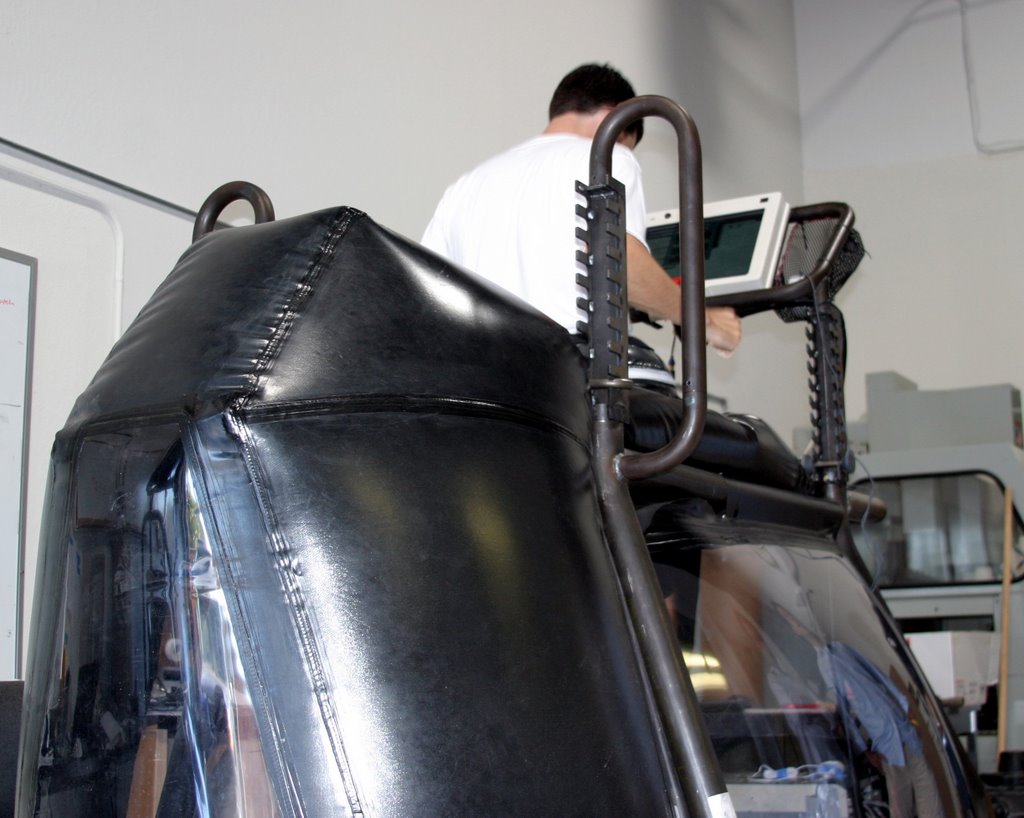 (Rear view of the G-Trainer; the clear windows were handy for checking posture,
and the brackets allow for pro athlete sized users)
Once I warmed up, I set the pressure to "60% bodyweight" and cranked up the speed. Before I knew it, I was running at 15 miles/hour...that's a 4 minute mile! It was fascinating that I could experience the turnover and stride length required to go this fast without breaking my body in half. Most sprinters wouldn't spend more than 5 minutes at full race pace in a season - with the G-Trainer, you could go full race pace every week.
I slowed down to a 7 minute mile and cruised for a while. My posture and alignment looked good, with no adjustment required for the G-Trainer. I pictured logging some long runs at 60% support, training my aerobic system, getting my body used to a solid pace, all without having to sacrifice my joints. It couldn't replace the long run, but I could certainly increase my mileage by supplementing it.
After my run, I talked with the Alter-G team - Sean Whalen, Brent Looney, Fritz Moore, and Eric Edelson - about the implications of such a system. Examples included:
- Rehabilitation - with anti-gravity support, you could begin rehab sooner and be back on your feet sooner. In fact, this is why the Oakland Raiders and Golden State Warriors both have one.
- Speed training - much like I experienced, you can train your body to know the turnover and stride length required to hit your top speed.
- High mileage - If supplemented, one could add considerable weekly mileage. Drop your weight by 10%, you can add 10% more mileage (actually, Alberto Salazar has his runners training at 90-97%, and swears it allows 10-25% more volume, on average - check his video testimonial)
- Obesity aid - can you imagine letting an obese person feel what it is like to be 50 lbs lighter as a start to their conditioning? Incredible pyschological power.
- Training for the elderly - for those losing their ability to support themselves, they can still train aerobically. The G-Trainer can supplement up to 80% of your bodyweight.
Check out Alter-G's web site to see more videos about how it works. There are even testimonials by Alberto Salazar, Robert Gallery (Oakland Raiders), and Chase Lyman (New Orleans Saints). Alter-G is an ambitious young company, and they are planning to have G-Trainers commercially available in 2007. For you investors out there, Alter-G is currently seeking venture investment for expansion. For all you bloggers out there, help Alter-G by linking to this story!
And since we're talking treadmills, I want to point you to this video by the band OK Go. I'll never look at a treadmill the same!
- SD
[P.S. - I have no financial interest in Alter-G.]
Monday, July 3, 2006
In case you haven't read "Runners", a short story by award-winning author Roger Hart, I thought I would reprint it in the blog (with permission). I can only hope to have such stories 20 years from now! Roger Hart is an Creative Writing Instructor at Ohio University, and boasts a 2:27:48 marathon PR. If you like this story, you can order Erratics, his collection of short stories that won the George Garrett Fiction Prize. Roger is currently working on a novel, and assures me he still gets out regularly to run!
Thanks to Alan Abbs for pointing me to this.
Enjoy, SD
Runners
BY ROGER HART
WE RAN THROUGH BLIZZARDS, THUNDERSTORMS, freezing rain, covered bridges, creeks, campgrounds, cemeteries, parks, a nuclear power plant, county fairs, and, once, a church service. We were chased by goats, geese, a crazed groundhog, guards (the nuclear power plant), a motorcycle gang, an armed man in a pickup, a sheriff's deputy, and dogs, both fierce and friendly. We ran when 2 feet of snow covered the roads, and when the windchill was 30 below. We ran when it was 80 degrees at seven in the morning. We ran on streets, sidewalks, highways, cinder tracks, dirt roads, golf courses, Lake Erie beaches, bike trails, across yards, and along old railroad beds. Seven days a week, 12 months a year, year after year.
During the hot days of July and August, Ed ran without a shirt or socks; I always wore both. Norm ran with a screw in his ankle and joked that it was coming loose. Ed was faster going downhill; I was better going up. The three of us met at a race and became training partners, competitors, best friends. We ran together on Saturday mornings, usually a 20-miler along the shore of Lake Erie or a 22-mile route over hilly country roads through Ashtabula County [Ohio]. We ran thousands of miles and more than a dozen marathons together, but most of the time we ran alone.
We gave directions to lost drivers, pushed cars out of snow banks, called the electric company about downed lines and the police about drunks. We saved a burlap bag full of kittens about to be tossed off a bridge, carried turtles from the middle of the road, returned lost wallets, and were the first on the scene of a flipped pickup truck.
We ran the Boston Marathon before women were allowed to enter and way before the Kenyans won. We were runners before Frank Shorter took the Olympic gold at Munich, before the running boom, nylon shorts, sports drinks, Gore-Tex suits, heart monitors, running watches, and Nikes.
We ate constantly, or so it seemed. My favorite midnight snack was cookie dough or cold pizza. Ed enjoyed cinnamon bread, which he sometimes ate a loaf at a time. Norm downed buttered popcorn by the bucketful and Finnish cookies by the dozen. We all loved ice cream, and drank large vanilla shakes two at a time.
Still, friends said we were too thin. They thought we looked sick and worried something was wrong.
We measured our lives in miles down to the nearest tenth, more than 100 miles a week, 400 a month, 5,000 a year.
The smells! From passing cars: pipe tobacco, exhaust fumes, and sometimes the sweet hint of perfume. From the places we passed: French fries, bacon, skunk, pine trees, dead leaves, cut hay, mowed grass, ripe grapes, hot asphalt, rotten apples, stagnant water, wood smoke, charcoal grills, mosquito spray, road kill. And from ourselves: sunscreen and sweat.
Some people smiled and waved. A few whistled. Once or twice women from passing cars yelled we had nice legs. Others, usually teenage boys in sleek, black cars, yelled obscenities, called us names, gave us the finger, and mooned us. They threw firecrackers, lit cigarettes, soda cans, half-eaten ice cream cones, beer bottles (both full and empty), squirted us with water, drove through puddles to spray us, swerved their cars to force us off the road, swung jumper cables out the window to make us duck, and honked their horns to make us jump.
We saw shooting stars, a family of weasels, a bam fire, a covered wagon heading west, and a couple making love in a pickup. We ran with deer on a golf course, jumped a slow-moving train to get across the tracks, hid in ditches during lightning storms, slid across an intersection during a freezing rain, and dived into Lake Erie to cool off in the middle of a hot run. We drank from garden hoses, gas station water fountains, soda machines, lawn sprinklers, and lemonade stands. We carried toilet paper, two quarters, sometimes a dog biscuit.
We were offered rides by "The Chosen Few" motorcycle gang, old ladies, drunks, teenagers, truckers, a topless dancer (not topless at the time but close, real close), and a farmer baling hay, but we never accepted a single one. We argued about the dancer.
We were nervous before races and said we'd quit running them when we weren't. We won trophies, medals, baskets of apples, bottles of wine, windbreakers, T-shirts, pizza, pewter mugs, running suits, shoes, baseball caps, watches, a railroad spike, and, once, $500. Often we didn't win anything, although we never looked at it that way.
Ed liked to race from the front and dare other runners to catch him. I preferred to start a little slower, stalk those who went out too fast, and sneak up on them around 20 miles when they began to look over their shoulders. I felt like a wolf, and they were the prey. When I passed, I pretended not to be tired, and never looked back.
Our goal was to qualify for the Olympic Trials Marathon, to run faster and farther, to beat other runners.
Did we ever have runner's high? Didn't it get boring? What did we think about? Why did we always look so serious? Sometimes. Sometimes. Running. We didn't know we did. One spring day it rained so hard the road was one giant ankle-deep puddle, and Ed was huffing, and our feet were splashing, and it struck us funny. We laughed until we collapsed, tears and rain running down our faces. We joked about the time Ed had to pee and caught himself showering a snake, the time we got lost during a winter storm and refused to turn around, and the time we ran by Don King's ranch and were mistaken for two boxers. (We never understood how anyone could mistake us for boxers, but we loved it.)
We felt guilty about the time we ran into a church service being held in the middle of a covered bridge, and were too tired, too inconsiderate, too stubborn to turn around, so we sprinted down the center aisle, dodging the two men with collection plates, and ran out the other end of the bridge while the congregation sang "Praise God from whom all blessings flow...'
And the dogs! The ones that tried to follow us home and the ones that attacked us. The time that Ed, Norm, and I yelled at a growling Doberman, and told it to go home. The owner jumped in his pickup, chased us down the dirt road, swearing he'd shoot us for bothering his dog. We ran through a field and across a four-lane highway, circled back through the woods, hid beneath the underpass, and then jogged into a gas station where we celebrated our escape with ice-cold Cokes.
Or the time a sheriff's deputy stopped his cruiser to protect us from a German shepherd as large as a Poland China hog in a nearby field. The dog jumped through the open window and landed on the deputy's lap, and, while they wrestled in the front seat, we ran, afraid of what might happen if either ever caught up with us.
We found pliers, purses, golf balls, bolt cutters, billfolds, money (once, over $200--returned to an 18-year-old boy--no reward, no thanks), tape cassettes, CDs, sunglasses, school books, porn magazines, a Navajo ring, car jacks, a fishing pole, a pair of handcuffs (no key), an eight ball, and a black bra (36C).
We ran farther and faster. We sprinted up long steep hills by the Grand River until all we could do was stagger. We ran intervals on a dirt track: 20 quarter-miles in under 70 seconds, the last lap in 56 flat. We got lightheaded, our hands tingled, and sometimes blood vessels in our eyes ruptured from the effort.
We ran because it beat collecting stamps, because we were running toward something, because we were running away, because we were all legs, lungs, and heart, because we were afraid of who or what might catch us if we stopped.
One winter, while running twice a day, I was on my way home from a 7-mile run, and I couldn't remember if it was morning or night, if when I finished I would shower and go to work or shower and go to bed. I looked at the horizon and the stars, the passing cars, and the lighted barns for a clue, but couldn't figure it out. Ed said one time he went out for a run and bumped into himself coming back from the previous one.
We lost toenails and we pulled muscles. We suffered frostbite, hypothermia, heat exhaustion, sunburn, blisters, dehydration, and tendinitis. We were stung by bees, bitten by black flies, and attacked by red-winged blackbirds. Sometimes, after a long run, speed workout, or a marathon, our legs would be so sore, our Achilles so inflamed, that we could barely walk, and we'd limp or shuffle painfully when going from the couch to the refrigerator or from the front door to the mailbox.
We treated aches with ice and heating pads, or soaked our legs in DMSO, sometimes in Epsom salts and hot water. We tried medical doctors, surgeons, chiropractors, acupuncturists, podiatrists, massage therapists, trainers, and quacks. We were given shots of novocaine and cortisone, told to take ibuprofen, Tylenol, and aspirin. We were warned that we were ruining our knees, our hips, damaging our feet, breaking down too much blood, that we would suffer arthritis and degenerative joints.
BUT SOMETIMES IT WAS LIKE FLOATING, as if you were sitting on top of a pair of legs that you didn't think would ever get tired or slow down.It was as if the legs were yours but they weren't.
It was as if we were part animal: a running, flying animal. A horse, a bird. It was like feet kissing the pavement and effortless strides, the body along for the ride. It was like sitting in Ed's '67 Corvette, that monster engine gulping high-octane fuel and turning 6,000 rpms, your foot ready to pop the clutch. Like freedom and invincibility. When we ran around comers, we were jets sweeping in formation.
We each had a resting pulse in the low 40s and body fat of 7 percent or less. I was 6' 2", raced at 148 pounds, and went through a pair of running shoes every 6 weeks.
Once, I experienced chest pains, a sharp stab beneath the ribs. A Saturday morning, 22-mile run. Seven steep hills. We raced up the first hill to find out if it was my heart or not, and when I did not drop, we raced up the second and third. After 6 miles the pain eased off, and Ed said if it had been a heart attack, it must have been a mild one. Thousands of miles later, a doctor unfamiliar with a runner's heart sent Ed to the emergency room where he was poked, prodded, hooked up, and given oxygen. Finally, Ed said enough was enough, pulled the IV, and ran home. Two weeks later, he set an age-50 record for the mile in a local meet.
Although we ran faster and faster, it was never quite fast enough. We failed to qualify for the Olympic Trials. Still, four times we drove for hours and slept in our cars to watch others compete for the three Olympic spots. Then, just as we once stalked other runners, time stalked us.
We began looking over our shoulders and thinking about the marathons we had run instead of thinking about the next race. We slowed down. Our bodies balked at 100-mile weeks, and it took longer to recover from a hard run. Sometimes when the weather was bad--very hot was always worse than very cold--we took a day off. Sometimes we would skip a day because we were sore or tired. We stopped giving the finger to those who ran us off the roads. We gained 5, 7, 10 pounds. More.
Now, Ed has a granddaughter; Norm has "screw pains," and I have a retirement clock and deformed toes. We've turned gray, lost hair, and joined AARP. We run 25, 30 miles a week. From time to time, we race, no marathons but shorter races, 3, 4 miles, maybe a 10-K. We measure our lives in days, months, and years, not miles.
Ed and Norm still live in Ohio; I moved to North Carolina, then to Minnesota. We no longer run together, but we keep in touch and reminisce about the time the newspaper ran a front-page story about a group of snowmobilers who had ridden nearly 10 miles on a day when the temperature was 5 below. We had passed them during a 20-mile run. We argue about who threw the rock at the house, whose fault it was we got lost, and which one of us the topless dancer really wanted to take for a ride.
We complain that we're running slower than we once did, and make jokes about timing ourselves with calendars and sundials. Sometimes when we're running we'll spot other runners ahead of us and the urge to race comes back, and we'll do our best to catch them. Last fall while I was running in a park, I overheard a high school coach urge his runners to pass "the old, gray-haired guy." I held them off for a mile although it almost killed me, and, when I had completed circling the park, I ran by the coach and said, "Old guy, my ass."
But my ass is getting old along with my other body parts. When I sometimes fantasize about one more marathon, the fantasy seldom lasts more than a day. Fast marathons and 100-mile weeks are things of the past.
And what did we learn from running 70,000 miles and hundreds of races, being the first to cross the finish line and once or twice not crossing it at all, those runs on icy roads in winter storms and those cool fall mornings when the air was ripe with the smell of grapes, our feet softly ticking against the pavement?
We learned we were alive, and it felt good. God, it felt so good.
Saturday, June 10, 2006
Pushing the limits: Athletes drawn to ultramarathons (Marin Independent Journal)
0 comments Posted by ai at 10:39 AMMike Sweeney and Dean Karnazes are featured in a great article about ultra events in the Marin Independent Journal. Mike is interviewed during the Ruth Anderson 100k, where he placed third overall. Journalist Rick Polito does a great job of getting into the heads of ultra athletes to find out why endurance sports are growing in popularity.
 (Mike Sweeney at the 2005 Badwater Ultra; photo courtesy of Luis Escobar)
One of my favorite quotes from sports pyschologist Joel Kirsch -
"That more people are being inspired and more people are "doing things that have never been done before" is to be expected. "More" is part of the human condition. "I think its part of the species to ratchet it up," Kirsch says.Be sure to check it out when you have a chance.
- SD
Wednesday, May 17, 2006
I had some requests for "recovery tips" after the Miwok 100k, and thought I would share what I wrote in case y'all missed it in the comments. I obsess about recovery because I like to race so much throughout the year, and I now have it down to a routine that works well for me. If you have any other tips, please share by commenting below! I'm always open to new ideas.
The general guideline for recovery is "one day off for every mile raced". Unfortunately that doesn't work very well if you're doing ultras (otherwise we would be on the couch most of the year). I prefer Hal Higdon's framework that refers to the recovery period as a "reverse taper", where you take a few days off, then slowly build back up to your peak (instead of tapering down for a race). Once I got my recovery process dialed, I have found I can recovery from a race in about 4-8 days then slowly build back up over 1-2 weeks.
After experimenting with various recovery techniques, I have found three easy things you can do to immediately improve recovery. I've also found a few time-consuming tricks that improve my recovery by 20-25%, so I will share those too.
Three Easy Recovery Tips
Some of these tips may be obvious to you die-hards who grew up with high school and collegiate coaches. I started my athletic career fairly late in life, so I learned most of these the hard way (lots of groaning and moaning). Take it from me - those coaches have you do these for a reason! The simple tips:
1. Respect the warm up. I'm probably the last one of the planet to figure this out, but it turns out that warm ups are important! By spending 5-10 minutes before a race or hard workout, you can smoothly transition your body and improve your recovery time. I play a mind game where I try to warm up as slowly as possible, Tai Chi style. Start by walking, then walk a bit faster, slowly building up to your race pace over 10 minutes. It's a test of patience (particularly on cold mornings), but is effective is slowly letting your blood flow increase and warming up your muscles. If you skip the warm up (ie, "this race is long enough I will just warm up along the way"), you're adding 12-24 hours to your recovery time.
2. Respect the warm down. When you cross the finish line, you are NOT done! Jog a bit, slow down to a fast walk, and ease out of the race. I often forget this one, since I'm thinking about nothing but "beer" and "chair" by the time I finish. But do it right, and it's worth 24 hours in recovery time.
3. In the first 15 minutes after a race, focus on the essentials - food, water, warmth. Grab some water/sports drink as you warm down, and take in some calories (glucose is fastest, carbs and proteins are essential). Your body needs fuel to repair your muscles, and is optimized for calorie absorption right after your race. Once you have warmed down, immediately change into warm, dry clothes. Get all these right, and you dramatically reduce your recovery time, and the risk of getting sick after a race.
Easy, right? Then be sure to do all three!
Other Recovery Tips
Below are some other tips that have worked well for me. I'm a big fan of "listening to my body", in that after 24 hours after a race I only take ibuprofen if necessary (a flight to NYC, for example). This gives me a chance to check my heart rate, feel my muscles and joints closely, and get an idea of how fast I am recovering. Remember, you earned this pain!
Here are some recovery tips that have worked for me:
1. Ice bath. Yes, it's painful, but I think it's worth 1-2 days of recovery. The sooner after your race (and warm down), the better. If there is a creek or lake nearby, wade in up your navel and soak it in for 10 minutes. Otherwise, get the ice bath going in your hotel room/bathroom when you get home.
2. Epsom salts. Epsom salts (which can be purchased at any grocery/drug store) help pull lactic acid from your muscles into your bloodstream. Add two cups to your bath (ice or otherwise), and give yourself a light massage while soaking for 10-15 minutes. This is worth a full day of recovery for me.
3. Check your resting heart rate every morning. I have used a heart rate monitor (HRM) for a few years now, and one the best uses I have found is checking your resting heart rate in the morning. I know my resting heart rate is about 38 beats per minute (I know it sounds low, but it's mostly genetic...thanks mom and dad!). The day after Miwok, I woke up with a heart rate of 45. 10-15% variance is normal; anything more, and I am definitely not working out that day. For me, it's typical for the HRM to keep me from working out for 1-3 days.
4. Light swimming. Regular swimming has been essential for me to keep up a high mileage week. I go twice a week and swim with a masters class, trying to keep the heart rate up and not worry too much about the fact that I'm getting my ass kicked by people twice my age. When recovering from a race, I go really slow and stay away from the fins. At the end of the swim session, I do 6 x 50 yards with 25 yards of kicking (no fins) and 25 yards of "running back", ie, slow underwater running.
5. Supplements. I've tried a bunch of supplements and have found most to be marginal in their recovery assistance. But I have had success with taking enzymes to help the body break down proteins and the such, much in thanks to prompting from my wife. I have found Hammer Nutrition's Tissue Rejuvenator to be a good mix of enzymes that improves my recovery time by 10-15%. When I'm really beat up (bruises and the such), I get a TRMA enzyme supplement from the health store. That stuff is miraculous if you're bruising, but fairly useless if not. I also take Vitamin E and a protein supplement - not sure if it helps recovery or not, but there you go.
Put it all together, and my post race recovery routine looks something like this:
Immediate after the race - Short jog, then walk for 3-4 minutes to cool down while drinking 12-16 oz of water or juice. Put on warm clothes, then eat everything in site to replenish my glycogen. Drink a beer and cheer on the other finishers for the next hour. If there is a creek, ocean, or cold lake nearby, wade in for 10 minutes.
Later that night - Take an Epsom salt bath (2 cups of Epsom salt, in ice if I'm looking for a fast recovery), and slowly massage your legs while in the bath. If I still feel stiff, I'll take a short walk or pedal on the bike for 10 minutes before going to bed. Drink 2 cups of water with my supplements, and hit the sack.
Day One - No running workout. Be super lazy, and keep my feet out of shoes as much as possible. I'll walk a bit here and there, but usually just go see a movie, play with the dog, and work on the blog. I do take more enzymes, as well as Aleve if I actually need to do something that day.
Day Two - No running workout. Measure heart rate. Hit the pool for some light swimming (30-40 min), no fins. No ibuprofen, but enzymes.
Day Three - If the HRM looks good, do a light workout on the elliptical trainer or bike (30 min) and some stretching; no sweating, just easy motion. No Aleve, go off the enzymes.
Day Four - If the HRM looks good, I might run 3-4 miles. Otherwise, back to the pool for slow swimming.
Day Five - If the HRM looks good, 5-6 mile run. Otherwise, rest.
Day 6+ - Ease back into the weekly workout, staying off sprints and hill repeats at first.
After Miwok, my heart rate was off for two days. My muscles recovered by day 4, but I felt some aching in my tendons and IT band that had me concerned, so I stayed in the pool until day 6. By day 7, I felt good enough to put on the shoes and do a light run. I feel ready for Ohlone this Sunday.
I hope that helps! Be sure to share any other tips you have found helpful.
Thanks,
SD
Saturday, April 15, 2006
Does ultrarunning improve memory skills? (article by Nobel laureate, James Watson)
0 comments Posted by ai at 8:58 AM
Dr. James Watson, Nobel laureate and co-discoverer of the double helix, recently wrote an article for Seed Magazine that talked about the latest studies regarding memory loss. One study he cited showed may show that distance running can reduce memory loss.
Here's a quick recap of the article:
* Storage of new information in your brain is based on a process called "neurogenesis", which produces new neurons in your brain to store information.
* You've heard that "you can't teach an old dog new tricks". It turns out that age does limit your ability to learn new things, because post-adolescence, the brain stops growing and neurogenesis only happens in the hippocampus (where memories are formed). A key part of retaining the ability to learn is to maximize the rate with which we can generate new neurons (nerve cells) as we get older.
* An experiment with mice has shown that when mice use treadmills to run long distances each day, they make new nerve cells at double the rate of their sedentary peers. This had yet to be tested on humans, but it is encouraging.
Please do go read Dr. Watson's article here. Even when he's pushing 80 years of age, he proves to be one of the most thought-provoking scientists of our time. Now if we can just get him to sign up for an ultra. ;-)
Takeaway - can't remember what to do today? Then GO RUN!
- SD
Tuesday, January 10, 2006
SPIT and SNOT – How you handle them may be more important than you think (guest blogger Dr. Larry Dunlap, MD)
0 comments Posted by ai at 6:57 AMOne of the joys of trail running is that body fluids can be discarded almost anywhere. Most of us have perfected our nostril and loogie ejections (ie, snot and spit) to the point it is a subconscious endeavor. But do we leave behind anything that we should be personally recycling to our own bodies? As disgusting as it sounds, would it be better for hydration and electrolyte balance to swallow rather than eject?
Every runner occasionally experiences times when thick saliva seems to build up in the throat or when the nostrils partially block with mucous. It takes little extra physical effort to propel that spittle to the trailside or, by occluding one nostril at a time with the index finger, expel nasal secretions to first one side then the other (as my son, Scott, calls it, the “snot cannon”). We feel better afterwards and air seems to flow more readily into our lungs. Mother Nature absorbs and repossesses our effluents so efficiently that most of us leave little trace in the wilderness. This is exactly as it should be. But I had always wondered if helping Mother Nature hydrate might be at the expense of our own hydration.
 (Proper mucus ejection technique!)
A quick tour of the nasal and oral system will help enlighten our internal capabilities. Mucous membranes line the nasal and oral cavities. The amount of mucous production can vary greatly among individuals and is highly influenced by allergies, air-born irritants, and infection. We know from our worst colds that maximum mucous production can be remarkably high. Thanks to pollen, dusts, and other allergies we also know that a thinner, clearer mucous can also be produced in impressive amounts. Mucus membranes work tirelessly, even as we sleep. Ordinarily everything is politely recycled by swallowing, except for the small portion that ends up in handkerchiefs, Kleenexes, or trailside. So here comes the question posed by this article: are we losing anything important when we return spit and snot to the earth instead of to our own stomachs?
Mucous and saliva are composed of protein, water, and electrolytes. Particularly important are the concentrations of potassium (about 30 meq/liter) and bicarbonate (50-70 meq/liters) which run approximately 6 and 3 times their respective concentrations in plasma. Sodium concentration is about l5 meq/liter. Bicarbonate loss increases the work of the kidney to reabsorb and re-form this compound, which is needed to buffer the lactic acidosis resulting from endurance exercise. The importance of maintaining general fluid and electrolyte balance is a well-documented essential for all cramp-free muscle performance, and it appears that there are high concentrations in the mucous and saliva we leave on the trailside. So we just have to figure out if the volume is significant.
The amount of saliva in each expectoration averages between 4cc. and 20cc (it wasn’t much fun but I’ve actually researched and measured this stuff – all in the name of science!). Likewise, when the nose is cleared, approximately 2-6cc. can emanate from each nostril. So the next time you go out running count the number of times you clear your nose or throat back to mother earth. The average sniff and spitter generates about 10cc of fluid with each episode. Clearing the nose or throat every quarter hour during a four-hour trail marathon places some 160cc of product along the race course. You might argue that 500 runners crossing Death Valley were a boon to adjacent plant life with this output! Truth is that, volume-wise, it’s not much. 160cc constitutes less than 6 ounces or the rough equivalent of an old fashioned, non-Starbucks cup of coffee. It would require only 6oz. of Gatoraid to replace the sodium, potassium, and water while the bicarbonate and protein loss is relatively minimal. Is this significant? Not very, at least not for most of us who pay close attention to estimating and replacing our losses during distance events. Yet when it comes to endurance running the less we have to remember to replace the better our outcome is likely to be. Unlike replacement drinks, our spit and snot is “us”. We don’t have to figure out those losses if we don’t loose them in the first place.
So the bottom line is that it is not just good etiquette to avoid spitting and clearing our noses while running, it is also a sound physiological act to swallow those vital body fluids and retain as much personal water, protein, and electrolyte as possible. If it feels better to externally clear your system, be sure to pull in a few extra ounces of fluid to account for it. But if you find it annoying, and there is someone in your training group that annoys you with their constant spitting or nose clearing, send them this article.
(Author Dr. Larry Dunlap is a runner and Emergency Medicine physician; he also happens to be my dad!)LinkWithin